
Building Regs guidance says "should"
But that doesn't make 55°C optional

The use of “should” in Part L guidance trips heating engineers up.
“Should” sounds like advice that you can take or leave depending on the customer.
It's not that simple.
The Building Regulations are the law
In England and Wales, the Building Regulations 2010 (the Regs) set the legal requirements for the design and construction of buildings.
The Regs are grouped in categories: Parts A–S.
Part L governs the energy efficiency of heating systems.
Scotland has its own regulations set out in Schedule 5, with energy efficiency covered under Section 6.
Heating work must comply with the law.
But the Regs are high level
The Regs describe the outcomes you need to meet, they don't tell you how to do it.
For example: Heating systems must be energy efficient, have suitable controls and be properly commissioned.
The guidance documents give you the detail
The official guidance documents give heating engineers practical ways to comply.
‘Approved Document L’ applies in England and Wales.
Scotland uses its ‘Technical Handbook’ and ‘Domestic Building Services Compliance Guide’.
In England and Wales, Approved Document L says the pipe and emitters should be designed to run at 55°C or lower for new and full replacement systems.
Scotland goes further to cover emitter replacements that exceed 50% of the calculated heat demand.
“Should” does not mean “optional”, it means one way to do it
It is important to understand that “should” gives you flexibility (where available) in how you comply, not whether you comply.
You can take a different approach, if you can show it still complies the Regs.
For the 55°C requirement, it's the only route to compliance
Boilers and heat pumps need to operate under 55°C to reach their higher efficiencies.
Where 55°C is really not feasible, the Approved Document L says to use the lowest temperature that will still meet the home’s heating needs.
The alternative is not to ignore flow temperature. It's to find the limiting factor and work out the lowest workable temperature.
A genuine lack of space may be a valid reason. Customer preference alone isn't.
The cylinder isn't a 55°C loophole
The installation may include a new cylinder or retain an existing cylinder.
In both instances the system may need to manage two temperature requirements, depending on the cylinder.
HSE advice for gas boiler systems is to store hot water at 60°C.
For boilers in new homes and retrofit, a two temperature set up (either via zone valves or controls) will satisfy both temperature requirements.
Got questions about low temperature systems?
It’s easy to get lost in the detail without the right foundations.
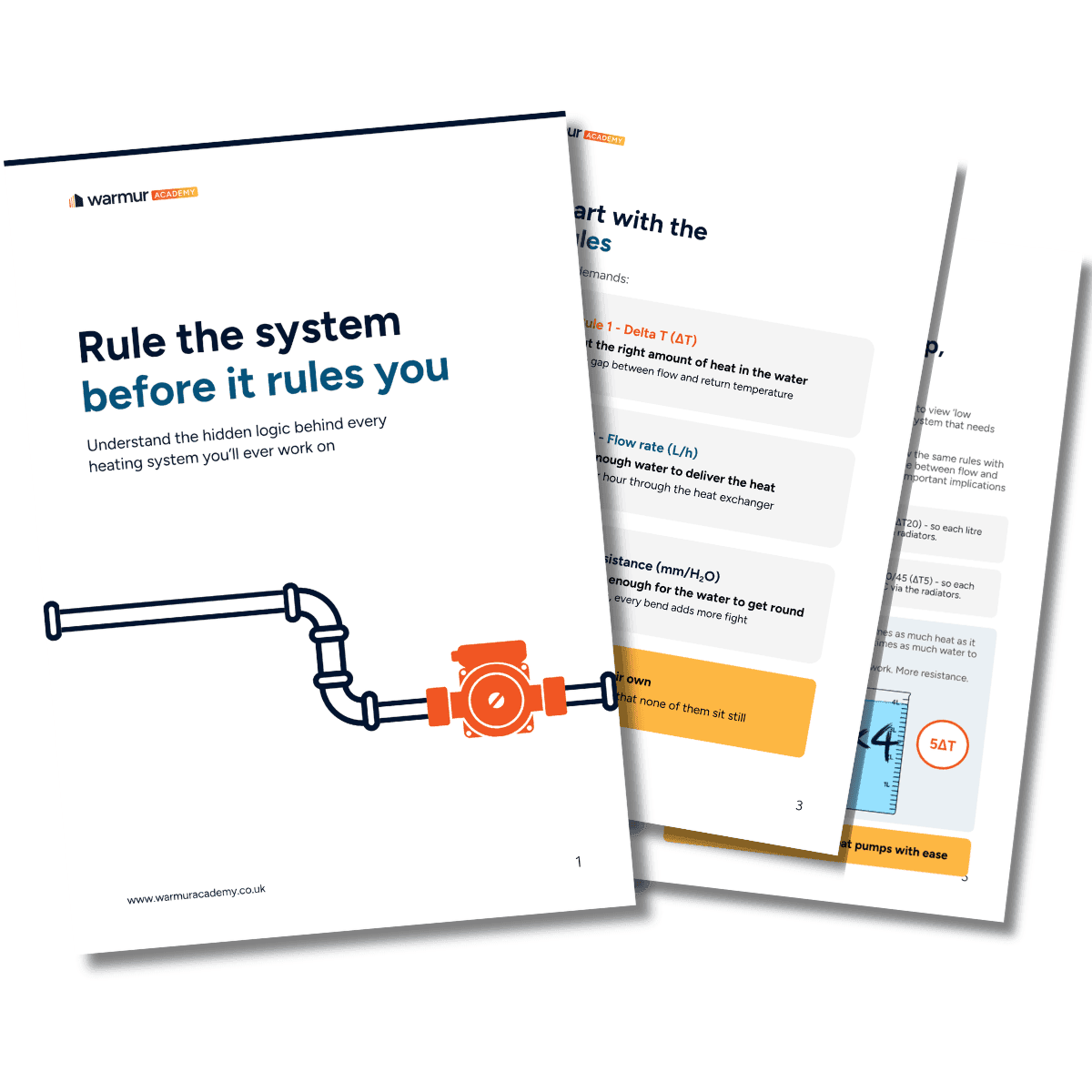
Start with our free ebook, Rule the System Before It Rules You.
Our quick, practical guide to the logic behind every heating system.
Warmur Academy’s approach
At Warmur Academy, we teach 55°C or lower as the starting point for new and substantially replaced wet heating systems.
But you can't just turn down the flow temperature on the boiler or heat pump.
The whole system should be sized to run at 55°C or less.
If the property genuinely will not allow 55°C, go to the lowest workable temperature.
I couldn’t recommend this course highly enough… it will make you stand out from your competitors.Phil M, Heating Engineer - Bucks
Rated 4.9/5 stars
by over 500 engineers