
Let engineers engineer.
Why heat loss is a drag on skills and productivity
Jo Alsop, 1 Dec 2025
Engineering - 1, U-values - 0
If we want heating engineers to have time to excel in their careers and deliver high performing heating systems, we need to strip out the distractions. Fast digital and third party heat loss calculations are already delivering multiple wins. The introduction of a simple manual MCS survey (as rumoured in industry forums) will drag us back a decade. We set out why it's time to drop heat loss competency from installer skill sets and embrace the digital era.
Introduction
In the recent Baxi Installer Skills survey, 46% of respondents cited ‘paperwork’ as the biggest barrier to switching to heat pump installations. MCS have themselves promised a re-balancing of their member-checks, away from back-office procedures towards engineering competency and execution.
As a training provider, we see first hand the enormous strain the workforce is under, not only to master new heating technologies, but to build ‘low-temperature’ design skills and meet a tougher, more demanding compliance regime.
Our view is increasingly that we need to drop what sandbags we can to ensure heating engineers have capacity to rise to a higher level of expertise. With digital solutions from Spruce, Warmur, Carno, Heatly and Heat Engineer now is the time retire heat-loss theory from core competencies and certainly not revert to pen and paper.
Three reasons to retire heat loss
- Engineers are motivated by engineering, not building pathology
- Digital surveying is more reliable
- Productivity unlocks capacity
1. Engineers are motivated by engineering, not building pathology
62% of respondents to the Baxi Skills Survey said they loved problem solving and 50% liked getting things right from a technical perspective. This appetite for learning and precision is a major, under-used asset in the transition and one the sector has yet to capitalise on.
As we build out our hydronics and controls training programme, we are hyper-focused on 1) what skills engineers need to deliver an optimised heat pump or boiler on the job tomorrow and 2) what motivates them to keep learning.
It’s a rigorous lens that tells us that heat-loss sits firmly in the administrative bucket of activities. Engineers need to understand why heat loss matters and how it shapes emitter and pipework sizing, but not how to calculate a composite U-value or heat transfer coefficients.
Dialling down heat loss and dialling up heating engineering fine tunes the educational experience to what actually makes a difference in the home. In a period when we are asking installers to invest a significant amount time and lost earnings into re-training, we owe it to them to make every hour count.
2. Digital surveying is more reliable
Heat-loss calculations already depend on assumptions, eg the state of cavity insulation or real air-change rates.
Digital tools can’t eliminate those, but they can remove the second layer of inaccuracy that comes from hand-measuring: the round-up! If we're not sure, we round up - window sizes, floor areas, vaulted ceiling heights. Cumulatively this plays a part in oversizing the installation.
Remote surveying, 3D scans, LiDAR and digital modelling avoid this by capturing the full geometry accurately and consistently, it literally maps and measures into every corner.
That aside, a digital starting point is the first step in a streamlined customer journey, which takes us neatly onto:
3. Productivity unlocks capacity
Processing one customer enquiry can easily consume 5–10 hours (a heat-loss survey, up to two site visits plus a quote). With a typical one-in-three conversion rate, that quickly becomes 15–30 hours of work for every job won. Sure, installers charge for surveys, but the hourly rate is low.
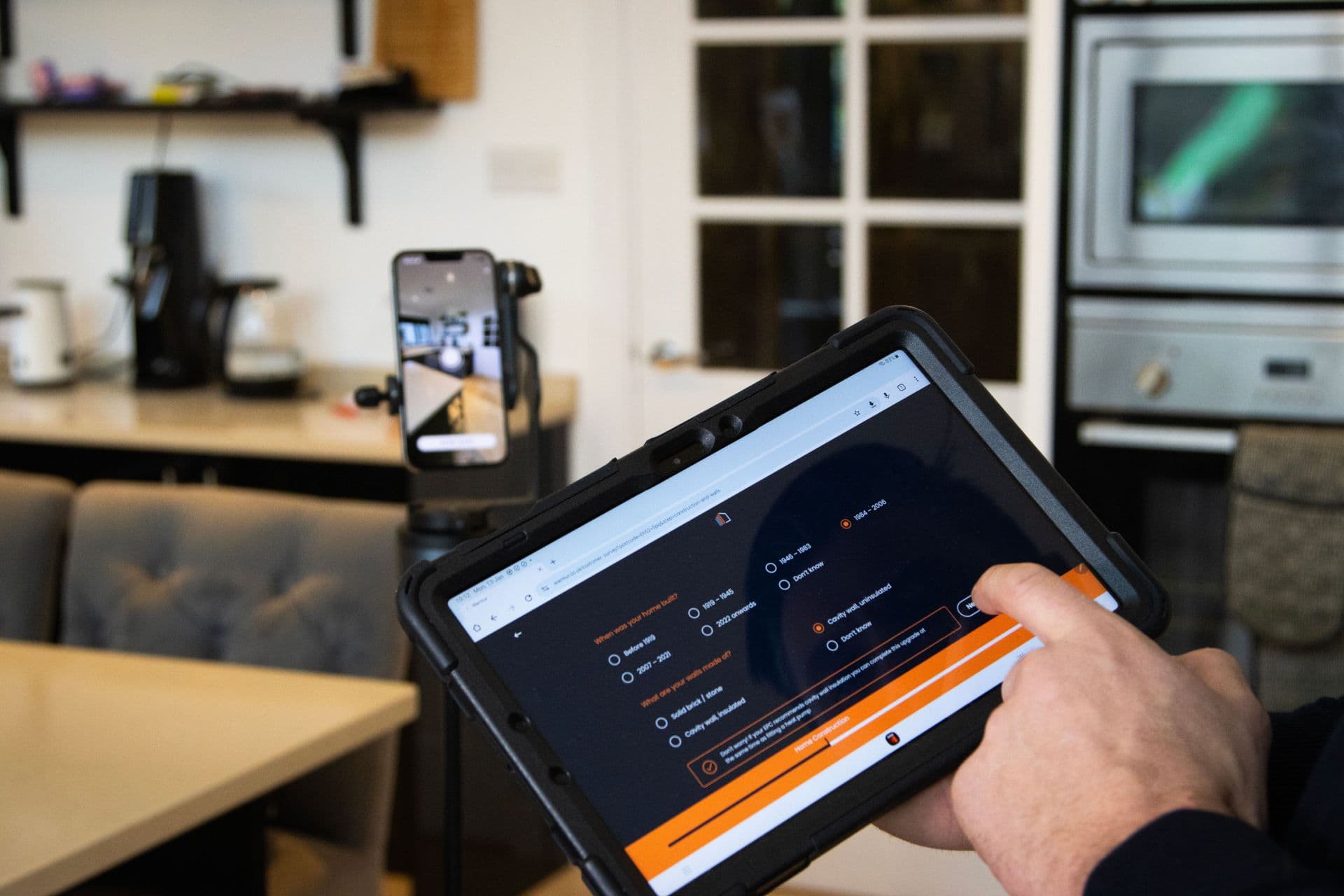
The last two years have been a time of rapid development in the sector with digital tools that can cut the entire process to an hour or two.
Manual heat-loss calculations pulls us in the opposite direction, squeezing time for developing important installation know-how and further reducing the installation capacity of an already undersized workforce.
Simply put, installers are too valuable to be standing in living rooms with manual processes when technology can do the same work better and faster and give their customers much greater confidence in its accuracy.
What good looks like
To make this shift real on the ground, here’s what we'd like to see happen next:
For industry
- Retire heat loss as theory from core installer training, or keep as an optional add-on.
- Focus qualifications on hydronics, optimisation, controls, commissioning - where heat loss is a design input.
- Provide digital heat-loss training to help installers understand the process and know how to work efficiently.
For installers
- Make software your starting point, its low cost, quicker and more accurate.
- Invest learning time in hydronics, commissioning and controls - the areas that actually determine system performance.
Join a course, step up in your career
If you’re a heating engineer, designer or heating professional who wants to turn theory into practice, Hydronics Unlocked is for you. Join a class and discover learning than transforms how you work.
The Warmur Method
Built around the 10 Steps.
Our 10 Step Hydronics framework follows the same order you'd tackle a real job and shows how each design decision affects system performance.
Survey
Understand the job.
Design
Understand the system.
Install
Put it to work.
Unlock your inner hydronics pro.
Whether you’re new to hydronics, looking to get qualified or want the complete package, we have training options to level up your skills.
I couldn’t recommend this course highly enough… it will make you stand out from your competitors.Phil M, Heating Engineer - Bucks
Rated 4.9/5 stars
by over 500 engineers